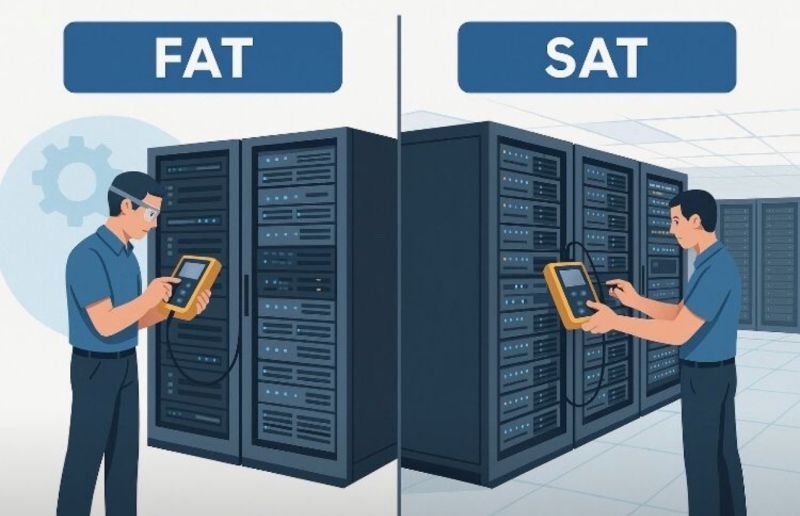
The full form of FAT and SAT is Factory Assessment Test and Site Assessment Test in Factory assesment.
Factory assesment is critical for ensuring operational efficiency.
Importance of Factory assesment
Understanding Factory Assessment in Detail
Through Factory assesment, we ensure all machinery is up to standard.
Regular Factory assesment helps in maintaining productivity.
Key Aspects of Factory Assessment
Factory Acceptance Test (FAT) is a formal test performed at the manufacturer’s site to verify that equipment, machines, or systems: Meet technical specifications Function correctly Are ready for delivery and installation at site, meeting the standards of Factory assesment.
Factory Acceptance Test (FAT) is a formal test performed at the manufacturer’s site to verify that equipment, machines, or systems: Meet technical specifications Function correctly Are ready for delivery and installation at site, essential for Factory assesment.
Purpose of FAT
- Detect problems before shipment
- Reduce commissioning time on site
- Confirm compliance with contract, drawings, and standards
- Get client approval before dispatch
Typical FAT Scope
Effective Factory assesment practices can greatly reduce costs.
Depends on equipment, but usually includes:
1. Documentation Review
- Approved drawings (GA, wiring, P&ID)
- Technical specifications
- Datasheets
- Software logic / PLC program
- Manuals (Operation & Maintenance)
2. Visual & Mechanical Inspection
- Dimensions and layout
- Material and finish
- Welding and fabrication quality
- Alignment and mounting
- Safety guards and covers
- Nameplates and tagging
3. Electrical & Instrumentation Checks
- Wiring as per drawings
- Cable labelingPanel layout
- Earthing/grounding
- Voltage, current ratings
- Instrument calibration (if applicable)
4. Functional Testing
- Power ON / OFF
- Start–stop sequences
- Manual and automatic modes
- Interlocks and permissives
- Alarm and trip functions
- Emergency stop (E-Stop)
5. Control System / PLC / HMI Testing
- I/O checking
- PLC logic verification
- HMI screens and commands
- Alarm display and reset
- Communication (if networked)
6. Performance Testing
- Capacity/output verification
- Speed, pressure, temperature checks
- Load or no-load tests(as per contract requirements)
7. Safety Testing
- Emergency stop response
- Safety interlocksLimit switches
- Compliance with safety standards
8. FAT Punch List
- Record deviations or issues
- Corrective actions agreed
- Responsible person and target date
FAT Documentation / DeliverablesFAT test proceduresCompleted FAT checklistTest results and recordsCalibration certificatesPunch list and closure reportFAT Acceptance Certificate (signed by client)
FAT vs SAT (Quick Difference)FAT → At manufacturer’s factorySAT (Site Acceptance Test) → At actual installation site
Who Attends FAT?Manufacturer / VendorClient or OwnerConsultant / Third-party inspector (if required)
What is SAT?
Site Acceptance Test (SAT) is the final testing carried out at the actual installation site after equipment is:
- Delivered
- Installed
- Connected to utilities and other systems
SAT confirms the system works under real site conditions.
Purpose of SAT
- Verify correct installation
- Confirm performance with actual utilities and loads
- Validate integration with other equipment
- Achieve final handover and acceptance
SAT Scope
1. Pre-SAT Checks
- FAT completed and approved
- All punch points from FAT closed
- Installation as per approved drawings
- Utilities available (power, air, water, raw material)
- Safety clearances approved
2. Mechanical Installation Verification
- Alignment and leveling
- Foundation and anchor bolts
- Piping and ducting connections
- Lubrication and oil levels
- Guards and covers installed
3. Electrical & Instrumentation Checks
- Power supply verification
- Earthing/grounding continuity
- Cable termination checks
- Field instrument calibration
- Loop checking
- Signal verification
4. Functional Testing
- Power ON / OFF
- Start–stop from local and control room
- Manual and automatic modes
- Interlocks and permissives
- Alarm and trip verification
For any Industry these are performed to test the reliability of the Hardware and the software before and after implementation, for the FAT the client have to go Factory to check all the relevant hardware before the delivery of the equipment to the site for the operation, during that time they to perform there test as per the manual specified, and the client have to check all the function thoroly, so they can give the green signal for further shipment and transfer to the site the activation and the configuration, there is also one Pre- SAT performed which means there is an internal test where the company themself have to check all the relevant parts and the functions for the shipment to the site.
By emphasizing Factory assesment, we prioritize safety.
Factory assesment is essential for compliance with regulations.
Consolidating results from Factory assesment can enhance future projects.
Successful Factory assesment ensures seamless operations.
A structured Factory assesment approach identifies weaknesses.
Investing in Factory assesment pays off in the long run.
Conducting a thorough Factory assesment is key to success.
Continuous Factory assesment leads to sustained improvements.
Efficient Factory assesment contributes to overall success.
Kadıköy Robotik Su Kaçağı Tespiti Tesisat haritası çıkarttılar, gelecekte çok işimize yarayacak. https://castaneafarms.com/
Great content! Keep up the good work!